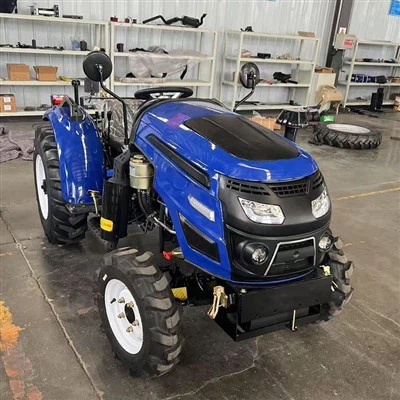
"In the past, after harvesting wheat, straw was either burned or discarded, polluting the environment and causing waste. Now, we use tractors to crush the straw and return it to the fields. This not only saves the cost of hiring workers to haul away the straw, but also makes the soil more fertile!" In the wheat fields of Xuchang, Henan, Zhou Jianjun, a large grain grower, watched as a tractor turned the shredded wheat straw into the soil with approval. Today, a wave of tractors equipped with environmentally friendly features are becoming "new helpers" in the green transformation of agriculture. From returning straw to fields to water-saving tillage, from deep application of organic fertilizers to recycling residual film, these technologies are helping farmers achieve both environmental protection and increased income.
Returning straw to fields reduces pollution, saving "double profits" per acre
"In previous years, dealing with straw after the wheat harvest was a major challenge-hiring workers to haul it away cost 50 yuan per acre, and secretly burning it could result in fines." Zhou Jianjun, who grows 120 acres of wheat, used to worry about the summer harvest. The tractor I replaced this year is equipped with a straw shredder and return device. After harvesting wheat, it can directly shred the straw into pieces smaller than 5 cm, which are then turned into the soil with a rotary tiller. "Not only do we not have to spend money on straw disposal, we also save money on fertilizer – killing two birds with one stone."
Zhou Jianjun calculated that returning straw to the fields increased soil organic matter content by 0.2 percentage points compared to previous years, and this year's wheat yield per mu increased by 80 kilograms. Combined with the savings on straw handling and fertilizer, this translates to an additional 120 yuan per mu of land, or 14,400 yuan for 120 mu of land. Data from the Xuchang Municipal Agriculture and Rural Affairs Bureau shows that over 3,000 local farmers are using straw return tractors this year, and the straw return rate has increased from 65% last year to 82%. The number of days with good air quality during the summer harvest increased by seven days compared to last year.
Water-saving farming conserves water resources, ensuring a good harvest even in drought-stricken areas.
"We're short of water here. It used to take two hours to pump water from the well to irrigate one acre of land. This year, using a tractor-mounted drip irrigation system, it only takes 40 minutes to irrigate one acre, saving half the water!" Farmer Wang Shuqin praised the tractor's water-saving features in her corn fields in Zhangye, Gansu. This tractor not only plows and sows, but also simultaneously lays drip irrigation tape. The drip tape, buried 5 centimeters below the soil, allows water to penetrate directly into the corn's root system, reducing water consumption by 50% compared to traditional flood irrigation.
Wang Shuqin also discovered that the tractor's seeding system allows for precise control of plant spacing. "Previously, manual seeding resulted in uneven planting, with some seedlings densely spaced and others sparsely spaced, leading to wasted water. Now, the machine sows the seeds at a consistent spacing, and the drip irrigation system evenly distributes water, resulting in even and strong corn seedlings." Zhangye experienced a mild drought this year, but Wang Shuqin's family's 20 mu (approximately 1,000 acres) of corn yielded 50 kilograms (approximately 100 catties) more per mu than last year thanks to water-saving farming. According to staff at the local agricultural technology extension station, over 1,500 farmers in Zhangye are now using water-saving tractors, saving nearly 2 million cubic meters of agricultural water annually.
Deep application of organic fertilizer improves fertility
reduces reliance on chemical fertilizers, and protects the soil.
"In the past, we applied chemical fertilizers to save time, which resulted in increasingly compacted soil over time. Now, using a tractor to apply organic fertilizer deep into the soil loosens it up, and the crops are growing vigorously!" Liu Qingguo, a farmer in Linyi, Shandong, began experimenting with deep application of organic fertilizer using a tractor this year. The tractor's fertilizer spreader precisely deposits decomposed organic fertilizer 20 centimeters deep into the soil, making it easier for crop roots to absorb than shallow application by hand and reducing nutrient loss.
"We used to apply 80 kilograms of chemical fertilizer per mu of land. Now, we mix it with 200 kilograms of organic fertilizer, reducing chemical fertilizer use by 30%. Corn yields per mu have increased by 60 kilograms compared to last year." Liu Qingguo said that more than 20 farmers in the surrounding area have followed his method of deep application of organic fertilizer. "Not only are the crops growing better, but there are more earthworms in the fields, and the soil is becoming more vibrant." Monitoring data from the Linyi Municipal Agriculture and Rural Affairs Bureau shows that farmland using tractors for deep application of organic fertilizer has a 12% lower soil bulk density than farmland with traditional fertilizers, and soil permeability has been significantly improved.
From returning straw to fields to reduce pollution, to water-saving farming to protect water sources, to deep application of organic fertilizer to improve soil quality, these "environmentally friendly" tractors lack complex gimmicks and instead use practical functions to help farmers increase their income while protecting the environment. As Zhou Jianjun said, "I used to think that environmental protection and making money were two separate things. Now, using tractors for green farming not only protects the land but also makes more money. This is the long-term solution to farming!" As more and more environmentally friendly tractors enter the fields, agricultural production is steadily moving towards "good ecology, high yields, and prosperous.