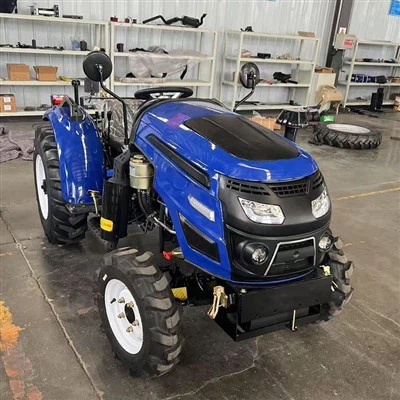
I. Core Areas of Technological Breakthrough: A Full-Chain Upgrade from "Perception" to "Decision-Making"
1. Multi-Dimensional Perception System: Accurately Capturing Farmland Micro-Data
The R&D team spent three years developing a "farmland data hub" for smart tractors, comprised of 12 sensor types. The soil moisture sensor utilizes high-frequency electromagnetic induction technology, penetrating 20 centimeters of soil to monitor soil moisture in real time with an error rate of ±2%. The crop growth camera, equipped with an AI-powered image recognition algorithm, can identify the growth status of crops like wheat and corn, and even identify early signs of pests and diseases. In a 2,000-acre wheat experimental field in Zhumadian, Henan, this system continuously monitored for 72 hours, generating plot-level "soil fertility distribution maps" and "crop growth heat maps," providing precise data support for subsequent operations.
2. AI Decision-Making System: Dynamically Adapting to Complex Agronomic Needs
Based on farmland sensing data, the tractor's built-in AI decision-making module automatically generates customized operation plans. For example, in plots of land with uneven fertility, the system adjusts the seeding rate from 20 kilograms per mu to a gradient distribution of 18-22 kilograms. In areas of compacted soil, the tillage depth is automatically increased from 12 centimeters to 15 centimeters. Farmer Li Jianguo reported, "In the past, adjusting agricultural machinery parameters based on experience often resulted in uneven seedling emergence. Now, the intelligent tractor automatically adapts, and the wheat emergence rate has increased from 88% to 96%." The system also allows farmers to manually modify parameters, balancing intelligence and flexibility.

3. Remote Control and Unmanned Swarming: Breaking Human Constraints
Leveraging 5G and Beidou dual-mode positioning (with centimeter-level accuracy), users can access three key functions through a mobile app: First, real-time monitoring, allowing users to view over 20 operating parameters, including tractor trajectory, fuel consumption, and engine temperature; second, remote control, enabling users to issue instructions for operations such as sowing and fertilizing from the office; and third, swarm management, enabling the coordinated operation of multiple tractors. In Shihezi, Xinjiang, an "unmanned swarm" of 10,000 mu (approximately 1,000 acres) of cotton fields, automatically achieves "staggered cultivation and seamless transitions" after setting operating boundaries via an app. This allows users to cover 2,000 mu (approximately 1,000 acres) of cotton per day, eliminating the need for six drivers compared to traditional manual operation and reducing labor costs by 60%.
II. Technology Implementation and Industry Impact:
Advancing Industrialization from "Pilot" to "Popularization"
1. Multi-Scenario Pilot Validation: Covering Mainstream Crops and Terrains
As of October 2024, smart tractors have been piloted in 12 provinces across China, covering eight major crops, including wheat, corn, cotton, and rice, and six terrain types, including plains, hills, and irrigated areas. In the rice-producing areas of the Sanjiang Plain in Heilongjiang Province, smart tractors, combined with rice transplanters, achieve "precision transplanting," saving 15% of seedlings per acre. In the apple-growing areas of Weibei, Shaanxi Province, smart tractors equipped with plant protection modules automatically adjust spray height and range based on the spacing between fruit trees, increasing pesticide utilization by 25%.
2. Cost Control and Capacity Planning:
Lowering the Barrier to Entry and Accelerating Popularization
The R&D team reduced costs through the localization of core components: sensor modules, previously imported, saw a 40% cost reduction after localization. The independently developed AI decision-making chip boasts 20% better performance than imported chips, at only one-third the price. It is expected that when smart tractors go into mass production in 2025, the retail price will drop from the current 350,000 yuan to 280,000 yuan, with an annual production capacity of 5,000 units. At the same time, the company has launched a "trade-in" policy, allowing farmers to exchange traditional tractors for smart models for an additional 10,000 yuan subsidy, further lowering the purchase threshold.
3. Promoting Agricultural Modernization: Improving Efficiency and Quality
The head of the Agricultural Mechanization Management Department of the Ministry of Agriculture and Rural Affairs stated that the promotion of smart tractors will drive the transformation of my country's agriculture from extensive farming to precision management. Data shows that farmland using smart tractors increases grain yields by 8%-12% per mu, reduces fertilizer and pesticide use by 15%-20%, and reduces overall farming costs by 10%-15%. It is expected that by 2026, the number of smart tractors nationwide will exceed 30,000, driving a 30% increase in overall agricultural production efficiency and contributing to the food security strategy of "storing grain in technology."