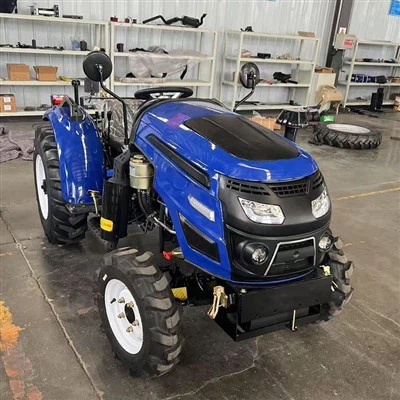
"In the past, orchard work was entirely manual. Fertilizing a 20-mu citrus orchard would have taken five people three days. Now, with this 'small' tractor, I can finish the job in half a day!" In a citrus orchard in Taizhou, Zhejiang, grower Chen Yongming steers a compact tractor, nimbly maneuvering between rows of fruit trees just 1.5 meters apart. Fertilizer dispensers on both sides of the tractor precisely apply organic fertilizer to the tree roots. These small tractors, designed for specialized planting scenarios like orchards, tea plantations, and greenhouses, are becoming a new helper for niche growers thanks to their flexibility, precision, and labor-saving features. The narrow tractor is suitable for navigating orchard alleys and can turn freely even with a row spacing of 1.2 meters.
"Traditional tractors are too wide to reach orchards, so tilling and fertilizing between rows of fruit trees had to be done manually, which was tiring and slow." Chen Yongming has been growing citrus for 15 years. His biggest headache used to be mechanized work in the orchard. The small tractor he currently uses is only 1.1 meters wide, nearly half a meter narrower than traditional models. With a minimum turning radius of only 2.8 meters, it can easily turn around in densely planted orchards with a row spacing of 1.2 meters without damaging the branches.
Even more conveniently, the tractor's operating equipment is customizable. To meet the fertilization needs of citrus orchards, adjustable-width fertilizer spreaders have been added to both sides of the tractor, allowing the fertilizer application range to be adjusted according to the row spacing of the fruit trees, avoiding fertilizer waste. For pruning in tea gardens, it can also be equipped with low-profile pruning blades, allowing for close-to-the-ground pruning without manual bending. "It used to cost 1,500 yuan to hire workers to fertilize a 20-mu orchard. Now, with a tractor, electricity and fertilizer costs only 300 yuan, saving nearly 10,000 yuan a year." Chen Yongming said that 12 citrus growers in the surrounding area have already switched to this type of narrow-body tractor.
Strong climbing ability conquers steep slopes in tea gardens, allowing operators to operate on 35-degree slopes without slipping
"Our tea gardens are all on the mountainside, with the steepest slope reaching 35 degrees. In the past, we could only carry 50 kilograms of fertilizer up the mountain by hand. Now, with a tractor, we can carry 500 kilograms at a time and even plow directly on the slope." Wang Xiulan, a tea farmer in Anxi, Fujian, praised the small tractor's climbing ability. This tractor is specifically optimized for mountain tea gardens: the rear wheels feature deep-tread, anti-skid tires that provide 30% greater grip than standard tires; and the chassis is equipped with anti-rollover brackets, ensuring stability and preventing tilting even on steep slopes.
Wang Xiulan also discovered that the tractor's power output can be precisely controlled-when working on gentle slopes, it adjusts to a low speed to save fuel; when climbing steep slopes, it switches to high-torque mode, providing ample power without slipping. "It used to take two days to manually plow one acre of tea garden, but now it can be done in two hours with a tractor. The soil is also loosened, allowing tea roots to grow better. This year's spring tea yield per acre is 15 kilograms more than last year." According to statistics from the local tea industry association, more than 80 tea farmers in Anxi have purchased small mountain tractors this year, increasing the mechanization rate of tea gardens by 25%. Low Height Suitable for Bending Down in Greenhouses, Able to Operate in Sheds as High as 1.8 Meters
"The greenhouses are too low for traditional tractors to fit in. I have to squat on the ground with a small hoe to till cucumbers and tomatoes, and my knees ache at the end of the day." Li Jianguo, a greenhouse grower in Shouguang, Shandong, switched to a "short-stature" tractor this year. With a height of only 1.6 meters, it can easily reach greenhouses with heights of 1.8 meters. The rotary tiller blades on the bottom of the tractor are adjustable, capable of tilling a maximum depth of 25 centimeters and a shallow depth of 10 centimeters, adapting to the growing needs of different vegetables.
"It used to take two people two days to cultivate three mu of greenhouse land. Now, with a tractor, it can be done in one day, and the soil can be raked and leveled at the same time, eliminating the need for manual leveling." Li Jianguo explained that tractors can also be equipped with drip tape laying devices, allowing them to lay drip tape directly after plowing the land, eliminating the manual installation process. "It used to take four hours to lay drip tape on three mu of land. Now, with a tractor, it can be done in one hour, saving a lot of effort."
From navigating narrow alleys in orchards, climbing steep slopes in tea plantations, to working low in greenhouses, these small tractors lack the high horsepower of traditional models, but their precise adaptation to specialized planting scenarios has solved the long-standing problem of mechanization difficulties for niche growers. As Chen Yongming put it, "Good agricultural machinery doesn't need to be 'high-end'. It's most practical if it meets the needs of our specialty crops, helps save labor, and improves efficiency!" With the development of specialty agriculture, these "small but sophisticated" tractors are becoming a "new engine" for increasing income for niche farmers.