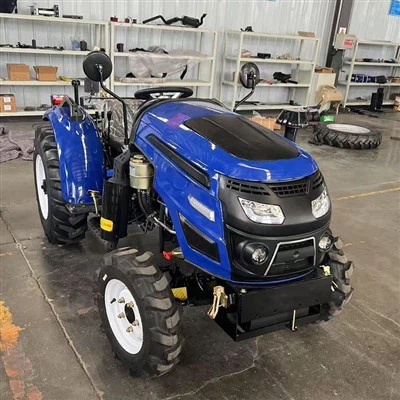
In mid-August, a conference promoting agricultural science and technology achievements was held in an agricultural demonstration zone. A new tractor intelligent obstacle avoidance technology was showcased, attracting the attention of numerous agricultural machinery operators, farmers, and agricultural technology experts. This technology revolutionizes the traditional tractor operation model, which relied on manual observation and obstacle avoidance. It ushers in a new era of intelligent tractor operation and injects new impetus into the development of intelligent and precise agricultural mechanization.
At a field trial site, a tractor equipped with an intelligent obstacle avoidance system was plowing the field. Without manual control by the operator, it smoothly followed a pre-set route. When it approached a raised mound in the field, sensors on the tractor's front end quickly detected the obstacle. Within milliseconds, the system automatically adjusted its direction, effortlessly circumvented the mound, and then precisely returned to its original route. The entire process was smooth and natural, without any pause. Agricultural machinery operators observing the demonstration expressed their amazement. "Before, when operating a tractor, I had to constantly keep my eyes focused on the road ahead, fearing I'd bump into obstacles like rocks and irrigation pipes. This would tire my eyes, and I'd sometimes accidentally bump into them. This not only delayed work progress but also required expensive repairs. With this intelligent obstacle avoidance technology, I can now work much more effortlessly."

When operating a traditional tractor, operators must constantly monitor the field environment and avoid obstacles like piles of dirt, rocks, irrigation systems, and utility poles. This intense concentration can easily lead to fatigue, increasing the likelihood of operator error. The new intelligent obstacle avoidance system, powered by advanced LiDAR sensors, high-definition cameras, and intelligent algorithms, provides real-time, accurate 360-degree environmental information around the tractor, with a detection range of up to tens of meters. The system rapidly analyzes and processes this information. Once an obstacle is detected, it immediately calculates the optimal avoidance path based on the obstacle's size, location, and tractor speed. The control system then precisely adjusts the tractor's steering and speed to automatically steer clear of the obstacle, eliminating the need for manual operator intervention. According to technical developers, to ensure the stable performance of intelligent obstacle avoidance technology in diverse field conditions, the team has conducted thousands of tests over the past two years across farmland ranging from plains to hilly and mountainous terrain, continuously optimizing the sensor's detection accuracy and the intelligent algorithm's response speed. Test data shows that using intelligent obstacle avoidance technology has increased tractor operating efficiency by approximately 20% compared to traditional manual operation. Tractors that previously could only plow 50 mu (approximately 60 acres) a day can now plow over 60 mu (approximately 60 acres). Furthermore, the incidence of tractor-obstacle collisions has decreased by over 80%, significantly reducing equipment maintenance costs and operational downtime.
Currently, this intelligent obstacle avoidance technology has entered a limited rollout phase, with tractors being installed and tested on some agricultural cooperatives and large-scale growers. The head of an agricultural cooperative gave feedback: "Our cooperative has 10 tractors equipped with intelligent obstacle avoidance systems. In the more than one month of use, there has not been a single collision accident. The operators all say that their work is much easier and the quality of their work is more stable than before." Agricultural machinery experts said that as intelligent obstacle avoidance technology continues to mature and become more popular, it will be further integrated with tractor automatic driving, precision fertilization and other technologies in the future to form a more comprehensive intelligent operation system, promote the development of agricultural mechanization to a higher level, and provide strong support for improving the quality and efficiency of agricultural production.