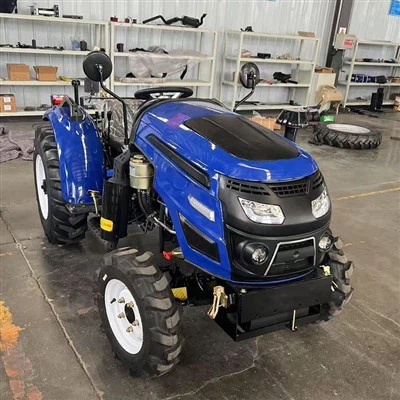
Tractors have always been an indispensable "star player" in farmland operations. Their powerful power and diverse functions have freed farmers from arduous manual labor, driving a leap forward in agricultural productivity. However, behind this "steel companion" lies a wealth of knowledge related to technology and application. Today, we'll delve deeper into the tractor's past, present, and core knowledge.
I. From "Steam Beasts" to Intelligent Equipment: The Evolution of the Tractor
The birth of the tractor stems from humanity's quest to replace animal power. The earliest steam-powered tractors appeared in Europe in the early 19th century. They weighed over a dozen tons and relied on coal for power. They were not only cumbersome to operate but also often became stuck in the field due to insufficient power. Their practicality was limited to a few flat plots. It wasn't until the early 20th century that breakthroughs in diesel engine technology led to the creation of the first diesel tractor. Its weight was reduced to 2-3 tons, while its power increased by more than three times. It could easily pull plows, harrows, and other farm implements, quickly becoming the mainstay of agricultural work and revolutionizing the traditional ox-drawn tillage model.
In the mid-to-late 20th century, tractors began to undergo a "functional upgrade." The advent of hydraulic suspension systems allowed tractors to flexibly connect to equipment such as seed drills, harvesters, and crop protection machines, achieving "multiple uses" for a single machine. Farmers no longer needed to purchase multiple implements, significantly reducing costs. The addition of electronic control systems enabled the instrument panel to display key data such as engine speed, operating speed, and fuel level in real time, significantly simplifying operation and making even novice operators quickly familiar with the technology. Today, intelligent tractors have entered the field: using satellite positioning, they automatically plan their routes with an accuracy of less than 5 centimeters. Sensors onboard can identify crop growth and automatically adjust fertilizer and irrigation levels, truly enabling "precision agriculture" and making farming more scientific and efficient.

II. Core Component Disassembly: The Tractor's "Power Code"
The key to a tractor's efficient operation lies in the coordinated operation of four core systems. First, the powertrain, the tractor's "heart." Mainstream models use diesel engines with power ranging from 20 to 300 horsepower. Small tractors with 20-50 horsepower are compact and maneuverable, suitable for delicate tasks in vegetable and orchards, such as weeding, fertilizing, and shallow tillage. Medium tractors with 80-150 horsepower offer moderate power and are suitable for plowing and sowing field crops in plain areas, capable of completing 100 mu (approximately 100 acres) of land per day. Large tractors with power exceeding 150 horsepower are powerful enough to tow large combine harvesters and deep tillers, making them the workhorses of large-scale farms covering 10,000 mu (approximately 10,000 acres) of land, achieving deep tillage efficiency exceeding 200 mu (approximately 10,000 acres) per day.
Second, the transmission system transmits engine power to the wheels or tracks. The core component is the gearbox. By switching between different gears, tractors can flexibly switch between "low-speed, high-traction" and "high-speed, convenient transportation." For heavy-duty operations like plowing and harrowing, low gear maximizes traction, easily turning deep soil and breaking up compacted soil. When transporting grain and farm implements, high gear allows for speeds of up to 30 kilometers per hour, making them as efficient as a small truck and solving the problem of post-harvest transportation difficulties.
The tractor's travel system determines its terrain adaptability and is primarily categorized as wheeled or crawler. Wheeled tractors offer high speeds and flexible turning maneuvers, making them ideal for dry, plain land, eliminating the need for additional transportation for daily plot transfers and increasing convenience. Crawler tractors have a large contact patch, minimizing soil compaction. Their strong grip allows for stable operation even in muddy paddy fields and on sloping terrain. Therefore, they are widely used in complex terrains such as southern rice-producing areas and the black soil of Northeast China, becoming a key piece of equipment for disaster relief operations. Finally, the operation system, which connects various agricultural implements via a rear or side mounting system on the tractor, is the core of achieving "full-process operation." Attaching a plow allows for deep tillage, improving soil aeration; connecting a seed drill allows for simultaneous furrowing, sowing, and covering, ensuring uniform seeding depth; using a sprayer allows for precise pesticide application, reducing waste; and even attaching a straw shredder can shred harvested straw and return it to the soil, improving soil fertility and achieving "circular agriculture."
Third, Choosing the Right Model for Your Needs: Adapting the Tractor to Your Production Needs
When choosing a tractor, it's important to tailor it to your cropping scale, terrain conditions, and crop type. If it is a family farm or vegetable garden with a planting area of less than 50 mu, a small wheeled tractor with 20-50 horsepower is the best choice. It is easy to operate and has low maintenance costs, and can meet the needs of daily weeding, fertilization, and shallow tillage. If you are planting field crops such as wheat and corn, with an area of 100-500 mu, a medium-sized wheeled tractor with 80-120 horsepower is more suitable. It can not only efficiently complete plowing and sowing, but also be paired with small and medium-sized harvesters to take into account harvesting and transportation. If it is a large-scale farm with an area of more than 10,000 mu, a large tractor or crawler tractor with more than 150 horsepower is more suitable. It can be adapted to large agricultural machinery and implements, greatly improving work efficiency and reducing labor costs.
Specialized models are available for specific scenarios. For paddy fields in southern China, "paddy field tractors" are recommended. These tractors feature wide, anti-sinking tires to prevent sinking into mud and impacting operations. For mountainous and hilly areas, tractors with hill-start assist are recommended. Their braking system is more stable, effectively preventing slipping when descending slopes and ensuring safe operation. For orchards, "low-profile tractors" are suitable. With a height of less than 1.5 meters, they can maneuver flexibly between rows of fruit trees, avoiding damage to branches and fruit, while ensuring both operation and crop protection.
From pioneers that transformed agricultural production models to intelligent pioneers that promote precision agriculture, the development of tractors has always been closely linked to agricultural needs. Understanding their technical principles and selection methods will not only help farmers improve production efficiency but also demonstrate the power of modern agricultural technology. In the future, with the development of new energy technologies, electric and hydrogen fuel cell tractors will gradually become more commonplace, injecting new momentum into the green and sustainable development of agriculture and broadening the path of "promoting agriculture through science and technology."