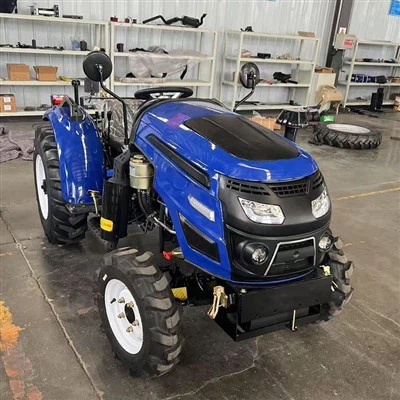
As a core piece of agricultural equipment, tractors operate throughout the entire farming process, from plowing and sowing to harvesting and transporting. Mastering key knowledge not only improves operational efficiency, but also extends equipment life and ensures safe operation. The following seven practical tips cover key scenarios, including tractor use, maintenance, and adaptation, and are suitable for farmers and agricultural machinery operators.
1. Functions of Tractor Core Components: Understanding the "Power Heart" and "Operation Joints"
The efficient operation of a tractor depends on the coordinated function of key components. Understanding the functions of these components allows for quick fault diagnosis and optimized operation:
Engine: This serves as the "power heart," burning fuel to generate power to drive the wheels and working devices. Engines of different horsepower are suited to different applications: Low horsepower (20-50 hp) is suitable for operating in confined areas like vegetable gardens and orchards; high horsepower (over 100 hp) is suitable for large-scale tillage and heavy-duty traction (such as pulling plows and trailers).
Transmission: Responsible for regulating travel speed and traction. A common combination of high and low gears, plus forward and reverse gears, can meet different needs: Low gears (such as 1-2) provide greater traction and are suitable for plowing and seeding; high gears (such as 4-5) offer greater speed and are suitable for transport and field transfers.
Hydraulic system: Controls the raising and lowering of the "three-point hitch" for attaching implements such as plows, harrows, and seed drills. During operation, be careful not to raise or lower the implement too quickly to prevent sudden drops and damage. Insufficient hydraulic fluid can cause ineffective lifting, so check the oil level regularly.
PTO (power take-off) shaft: Located at the rear of the tractor, it rotates to power implements such as harvesters and balers. A protective cover must be used when operating (to prevent entanglement), and the tractor and implement speeds must match (e.g., 540 rpm or 1000 rpm) to prevent damage.
2. Choose the right tractor type based on the application: Avoid using a "big horse pulling a small cart" or a "small horse pulling a big cart."
Tractor requirements vary greatly across different agricultural scenarios. Choosing the wrong type can lead to low efficiency and high costs:
Wheeled tractors: The most common type, available in two-wheel drive and four-wheel drive configurations. Two-wheel drive tractors are suitable for transport and shallow tillage on flat land; four-wheel drive tractors have superior traction and are suitable for muddy, sloping land, or deep tillage (such as the black soil in Northeast China), but they also have higher fuel consumption and a slightly higher purchase cost.
Crawler tractors: They offer a large contact patch and low pressure, making them suitable for soft soil (such as paddy fields and swamps in southern China). They resist sinking and reduce soil compaction. However, they are slow and require trailers for relocation, making them suitable for long-term operations in fixed locations.
Orchard/Greenhouse Tractors: With a narrow chassis (1.2-1.5 meters wide) and a low height, they can maneuver flexibly between rows of fruit trees or within greenhouses, avoiding collisions with trees or greenhouse frames. Typically low horsepower (20-40 hp), suitable for small implements (such as orchard tillers and trenchers).
Multi-purpose tractors: Equipped with a front loader or rear excavator, they can handle tilling, hauling (such as shoveling soil and moving fertilizer), and digging (such as digging irrigation ditches). They are suitable for small and medium-sized farms, offering a "one machine, multiple uses" approach and reducing equipment investment.
III. Pre-Operation "Three Checks" to Prevent Mid-Operation Failures
Spending 10 minutes performing "three checks" before starting your tractor can significantly reduce the likelihood of failures:
Fluid Checks: Check the engine oil (use a dipstick to check for levels between "min" and "max"), the hydraulic oil (check the fuel tank's oil level window), and the coolant (the tank should contain enough liquid to cover the radiator. If insufficient, add antifreeze; avoid tap water to prevent scale buildup).
Component Inspection: Check tires (check for proper pressure, stones, wire, and other debris trapped in the tread to prevent punctures), PTO shaft (check for secure connections and protective covers), hitch suspension (check for tight pin insertion and wear).
Electrical Inspection: Before starting, check the battery terminals (check for corrosion; if present, sand them). Lights (check for proper function of the headlights, turn signals, and taillights, essential for nighttime operation). Horn (provides a warning to prevent collisions in the field).
Note: If the tractor has not been used for an extended period (e.g., winterized), charge the battery before starting. Check the engine oil for deterioration (if cloudy or has an odor, replace the oil).

IV. The "Four Don'ts" Principle for Tractor Field Operations: Improving Efficiency and Safety
During field operations, improper operation not only affects work quality but can also cause safety accidents. The "Four Don'ts" principle must be adhered to:
Don't slam on the accelerator or brakes: When starting, slam on the accelerator slowly to avoid a sudden increase in engine speed that could put sudden stress on the implement. Reduce speed early when braking, especially when carrying a load (such as a trailer or plow). Slamming on the brakes can easily cause the implement to lose control or tire slip.
Don't Overload: Match the implement to the tractor's horsepower. For example, a 50-horsepower tractor should not tow a plow longer than 1.8 meters (this can cause engine overload, black smoke, and excessive temperatures). When transporting, do not exceed the load specified in the manual (for example, a 1-ton tractor should not pull 2 tons of cargo to avoid transmission damage). Do not turn or park on slopes: When operating on slopes, try to stay within the contour line and avoid sideways driving (which can easily cause rollover). If you need to stop, apply the parking brake and place rocks under the wheels to prevent rolling. Do not idle for extended periods on steep slopes (which can lead to insufficient engine fuel).
Do not ignore unusual noises or odors: If you hear unusual noises such as "clicking" (possibly a loose PTO shaft) or "squeaking" (possibly a belt slippage), or smell a burning odor (possibly an overheated brake pad) or engine oil (possibly an oil leak) during operation, stop the machine immediately and inspect it. Do not continue operating.
V. Special Maintenance of Tractor Tires: Impacting Operational Efficiency and Soil Protection
Tires are the key component of a tractor's contact with the ground. Improper maintenance can affect traction and soil quality.
Adjust tire pressure as needed: Different tire pressures apply to different terrains. For hard terrain (such as concrete or dry land), slightly higher tire pressures (e.g., 1.8 bar for the front tires and 2.0 bar for the rear tires) reduce driving resistance. For soft terrain (such as paddy fields or muddy land), slightly lower tire pressures (e.g., 1.2 bar for the front tires and 1.5 bar for the rear tires) increase contact patch and prevent the vehicle from sinking.
Check tire wear regularly: Tires with a tread depth less than 1.6 mm should be replaced (especially when working in paddy fields, where shallow treads can easily cause slippage). Cracks on the sidewalls (mostly due to aging or impact) should not be used, as they can cause blowouts. Prevent soil compaction: When working, try to use fixed routes (such as field ridges) and avoid repeatedly rolling over the same field (especially after sowing, as tire compaction can affect seed germination). If conditions permit, install wide tires or track shoes to reduce soil pressure.
VI. Five Preventative Measures for Long-Term Tractor Storage: Extending Equipment Life
Tractors need to be stored for extended periods during the off-season (such as winter). Five preventative measures can help prevent component damage:
Prevent Rust: Clean the tractor exterior (remove dirt and weeds), apply rust-inhibiting oil to exposed metal parts (such as hitch pins and PTO shafts), keep the fuel tank full (to reduce air ingress and prevent rust on the tank walls), and add fuel stabilizer (to prevent fuel deterioration).
Prevent Battery Discharge: Disconnect the battery terminals (negative terminal first, then positive terminal), remove the battery and store it in a dry, warm place (such as indoors). Charge it monthly (to prevent sulfation and extend battery life). Prevent tire deformation: Park the tractor on a flat surface. If the tractor will be stored for more than three months, use a jack to lift the tires off the ground (to prevent prolonged pressure that could cause tire deformation and tread degradation).
Prevent engine oil deterioration: Replace the engine oil and oil filter before storage (old oil contains impurities and can corrode internal engine components if stored for a long time). If possible, replace the hydraulic oil in the hydraulic system with fresh oil.
Prevent rodents and insects: Place mothballs or rat poison in the tractor cab and engine compartment (to prevent rodents from chewing electrical wires and hoses). Cover the tractor with plastic sheeting (to prevent dust and rain from entering), but leave gaps for ventilation (to prevent moisture and mold).
VII. "Quick Troubleshooting" Common Tractor Faults: Reducing Downtime
If you encounter minor malfunctions during field operations, quickly troubleshooting them can save time waiting for maintenance personnel. The following are troubleshooting methods for three common faults:
Unable to start: First, check the battery (check for loose terminals and power; jumper test); then check the fuel (check for fuel in the tank and fuel filter clogged; try replacing the filter); finally, check the circuit (check for carbon deposits on the spark plugs; if so, clean them with sandpaper; for diesel vehicles, check for clogged injectors).
Lack of power during operation: Check the engine oil (check for incorrect oil type; using winter oil in summer can increase resistance); check the air filter (check for clogs, especially when working in dusty fields; remove and tap to clean); and check the hydraulic system (check for insufficient hydraulic fluid; insufficient hydraulic fluid can slow implement raising and lowering, indirectly increasing engine load). If the hydraulic system isn't working: Check the hydraulic oil level (to see if it's too low); check the hydraulic oil lines (for leaks, especially at the joints; tighten or replace the seals); check the hydraulic pump (if the pump is silent after starting, it may be damaged and require professional repair. First, check the pump wiring for loose connections).
Reminder: If the problem cannot be corrected yourself (such as unusual noises inside the engine or transmission oil leaks), do not force repairs. Contact a professional repair technician to prevent a minor problem from becoming a major issue.