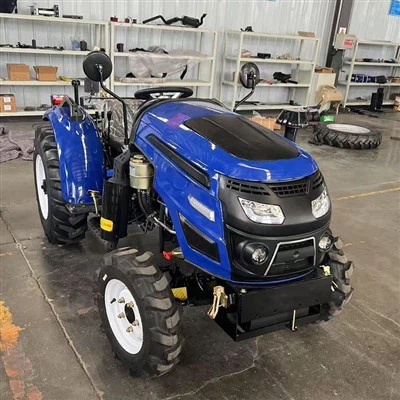
Since its implementation at the beginning of the year, the 2025 agricultural machinery scrapping and replacement subsidy policy has continued to expand in major grain-producing regions such as Henan, Shandong, and Jilin. As the September harvest season approaches, farmers across the country are enthusiastically replacing old machinery with new tractors. To date, over 5,000 households nationwide have benefited from this policy, and the newly purchased tractors are gradually being put to use assisting with harvesting crops such as corn, soybeans, and rice, injecting "mechanical power" into the harvest.
This subsidy policy further optimizes the 2025 policy. First, it expands the scope of subsidies to include tractors equipped with operational data monitoring and intelligent diagnostic capabilities as key subsidized items. Farmers purchasing such equipment can enjoy a 30% purchase subsidy, with the maximum subsidy per unit increased to 35,000 yuan. Second, it increases the compensation standard for scrapping old agricultural machinery. For tractors with a service life of 20-40 horsepower and over 10 years, the scrapping subsidy is increased from 2,000 yuan to 3,000 yuan per unit. The scrapping compensation for some high-energy-consuming and high-polluting older models is even doubled. In Zhoukou, Henan, farmer Zhang Jianguo did the math: "My 12-year-old tractor is worth a 3,000 yuan subsidy when scrapped. My new 45-horsepower tractor originally cost 85,000 yuan, but with the purchase subsidy, I saved 25,500 yuan, so I only spent a little over 50,000 yuan, which is significantly cheaper than buying a new machine in previous years."
To make it easier for farmers to take advantage of these policies, local agricultural machinery departments and dealers have launched a "one-stop service." At the Dezhou Agricultural Machinery Service Hall in Shandong, farmers simply bring their ID card and old machine registration certificate, fill out an application form, and dealers will assist them in completing the entire process of evaluating their old machine, selecting a new one, and applying for subsidies. The average processing time has been reduced from seven days to three. "Before, applying for subsidies required going to several departments, but now I can complete all the procedures right at the dealership, and the subsidy is deposited into my bank account in about 10 days. It's so hassle-free." Li Hongmei, a farmer in Ningjin County, Dezhou, had just finished her paperwork and was waiting for her new tractor to be delivered.

The newly commissioned tractors are not only more cost-effective, but also feature optimized performance and functionality tailored to the needs of the autumn harvest. For example, the 45-50 horsepower models commonly chosen by Henan farmers feature new fuel-saving engine technology, reducing hourly fuel consumption by 15%-20% compared to older models. Based on an average eight-hour operation during the autumn harvest season, this saves 5-6 liters of diesel per day. The air-conditioned cab and shock-absorbing seat eliminate the "steaming, back-breaking" ride experienced with older models in the summer, allowing operators to work for four hours straight without feeling fatigued. Furthermore, some models are equipped with operational data monitoring terminals, allowing farmers to view daily operating area and fuel consumption through a mobile app, and even receive remote equipment failure alerts. Wang Tao, an agricultural machinery technician in Songyuan, Jilin Province, stated, "The failure rate of these new tractors has been reduced by over 40% compared to older models, while operating efficiency has increased by 30%. Based on current progress, the local autumn harvest cycle is expected to be shortened by 5-7 days, effectively mitigating the impact of late frost on grain yields."