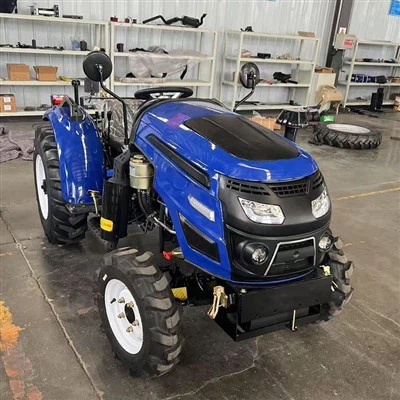
Farm tractors are commonly categorized into two-wheel drive (2WD) and four-wheel drive (4WD) models, each tailored to distinct farming scenarios-from small-scale vegetable plots to large-scale grain fields. 2WD tractors, with power delivered only to the rear wheels, remain popular for light, flat-terrain tasks due to their simplicity and lower cost. 4WD tractors, which send power to all four wheels, dominate heavy-duty or uneven-terrain work thanks to stronger traction and load-bearing capacity.
Their differing designs-from drivetrain structures to tire setups-lead to significant variations in maintenance needs. Below is a detailed breakdown of 6 key maintenance differences to help farmers optimize tractor performance and extend service life.
1. Drivetrain Structure & Component Maintenance
The drivetrain, which transfers engine power to the wheels, is the core distinction between 2WD and 4WD tractors, directly impacting maintenance complexity and frequency.
2WD Tractors: Feature a simplified drivetrain with only a rear differential, rear axle shafts, and a single driveshaft connecting the engine to the rear wheels. With fewer moving parts, maintenance focuses on basic upkeep:
Inspect the rear differential oil every 500 operating hours, replacing it every 1,000–1,500 hours (using SAE 80W-90 gear oil).
Check rear axle seals annually for leaks-worn seals (costing $20–$50 each) can be replaced in 1–2 hours without specialized tools.
The 2WD drivetrain rarely needs major repairs; a well-maintained system can last 8,000+ hours before requiring axle overhauls.
4WD Tractors: Have a more complex drivetrain, including a front differential, transfer case (to split power between front and rear wheels), and two driveshafts (front and rear). Maintenance tasks are more intensive:
Service the front and rear differentials separately-check oil levels every 300 hours, replace oil every 800–1,200 hours (using heavy-duty gear oil with anti-wear additives).
Inspect the transfer case every 400 hours: clean its filter, check for fluid leaks, and lubricate linkage components to ensure smooth power distribution.
The transfer case is a high-risk component; neglecting maintenance can lead to gear stripping, costing $800–$2,000 in repairs and 4–6 hours of downtime.
Maintenance Tip: For 4WD tractors used in muddy conditions, rinse the front differential with low-pressure water after each use to remove debris-caked mud accelerates seal wear and corrosion.
2. Tire & Wheel Assembly Care
Tires and wheels bear the tractor's weight and transmit traction, and their maintenance needs differ based on 2WD/4WD design and usage scenarios.
2WD Tractors: Typically use narrow front tires (for steering) and wider rear tires (for power delivery). Maintenance is straightforward:
Check rear tire pressure weekly (18–22 PSI for field work, 30–35 PSI for road travel) to prevent uneven wear-underinflation can reduce tire life by 30%.
Rotate front tires every 1,500 hours (since steering causes uneven tread wear) and replace rear tires every 3,000–4,000 hours (depending on terrain).
Front tires are low-cost ($150–$300 each) and easy to replace with basic hand tools.
4WD Tractors: Use equal-sized, wide tires on all four wheels (for balanced traction) and often have heavier wheel hubs with more bearings. Maintenance requires extra attention:
Maintain uniform tire pressure across all four wheels (16–20 PSI for field work)-even a 2 PSI difference can cause uneven power distribution and drivetrain strain.
Inspect wheel bearings (front and rear) every 600 hours: clean old grease, repack with lithium-based grease, and check for play-worn bearings ($50–$100 each) can damage hubs if not replaced promptly.
4WD tires are more expensive ($400–$800 each) and require professional mounting due to their weight; rotating them every 1,000 hours extends lifespan by 25%.
Real-World Example: A 2WD tractor used for mowing on flat land can go 4,000 hours on a set of rear tires, while a 4WD tractor tilling hilly, rocky soil may need tire replacement after 2,500 hours.
3. Traction Control & Steering System Maintenance
Traction control and steering systems adapt to different terrains, and their maintenance needs reflect 2WD/4WD's varying performance goals.
2WD Tractors: Rely on rear-wheel weight (often with added ballast) for traction and use a simple mechanical steering system. Maintenance tasks include:
Check steering linkage every 300 hours: tighten loose bolts and lubricate pivot points to prevent "play" in the steering wheel.
Add rear ballast (e.g., weights, liquid-filled tires) as needed for heavy tasks (e.g., plowing)-remove ballast for light work (e.g., spraying) to reduce tire and axle strain.
Mechanical steering rarely fails; most issues (e.g., stiff steering) are fixed by replacing a $10–$20 tie-rod end.
4WD Tractors: Use a "traction boost" system (e.g., differential locks) to prevent wheel slip and often have power steering for easier control. Maintenance is more involved:
Test front/rear differential locks every 200 hours-engage them on a gravel surface to ensure both wheels spin evenly; clean lock solenoids if they fail to engage.
Service power steering fluid every 500 hours: drain old fluid, flush the system, and refill with ATF (automatic transmission fluid) to prevent pump damage.
Power steering pumps are critical-low fluid levels can cause pump failure, costing $300–$600 to replace and leaving the tractor inoperable.
Practical Tip: For 4WD tractors used in wet fields, engage differential locks only when wheel slip occurs-constant use increases drivetrain wear.

4. Brake System Maintenance
Brakes slow or stop the tractor, and their design differences between 2WD and 4WD models affect how often and how they're serviced.
2WD Tractors: Use rear-only mechanical brakes (often drum-style) with a simple cable or rod linkage. Maintenance is minimal:
Adjust brake linkage every 400 hours to compensate for pad wear-loose brakes increase stopping distance and risk accidents.
Replace brake pads every 2,000–3,000 hours ($30–$60 per set); drum cleaning (to remove dust and debris) takes 30–60 minutes.
2WD brakes are low-maintenance but less powerful-they're sufficient for light tasks but require more distance to stop when hauling heavy loads.
4WD Tractors: Feature four-wheel brakes (disc or drum-style) and often have a "parking brake" that locks both front and rear brakes. Maintenance demands more care:
Inspect front and rear brake pads/shoes every 300 hours-disc brakes need caliper cleaning to prevent sticking, while drum brakes require adjustment for even wear.
Service the parking brake cable every 500 hours: lubricate the cable and adjust tension to ensure it holds the tractor on a 15° slope.
4WD brake components are more expensive ($80–$150 per set) but last longer (2,500–4,000 hours) due to balanced load distribution.
Safety Note: For 4WD tractors used to haul trailers, check brake fluid levels (for hydraulic brakes) before each use-low fluid can cause brake failure, especially when descending hills.
5. Weight Distribution & Suspension Maintenance
Weight distribution impacts tire wear and stability, and 4WD tractors' heavier design adds suspension-related maintenance needs absent in 2WD models.
2WD Tractors: Have a front-light, rear-heavy weight distribution (60–70% of weight on rear wheels) and no dedicated suspension (relying on tire flex for shock absorption). Maintenance focuses on:
Avoid overloading the front end (e.g., with heavy loaders) to prevent premature steering component wear-2WD tractors are only rated for front loads up to 10% of their total weight.
Check tire sidewalls for cracks every 6 months-overloading can cause sidewall bulging and blowouts.
4WD Tractors: Have balanced weight distribution (50–50% front/rear) and often include front suspension systems (e.g., leaf springs, hydraulic shocks) for rough terrain. Maintenance includes:
Inspect front suspension components every 400 hours: check leaf spring bolts for tightness and hydraulic shocks for leaks-worn shocks ($100–$200 each) reduce stability and increase tire wear.
Avoid sudden weight shifts (e.g., dropping a loader bucket quickly)-this strains the suspension and can bend front axles.
Example: A 2WD tractor with a 500-lb front loader may experience steering linkage wear after 1,500 hours, while a 4WD tractor with the same loader (and front suspension) can go 2,500 hours without issues.
6. Seasonal Maintenance & Task-Specific Care
Seasonal changes and task demands require tailored maintenance for 2WD and 4WD tractors, as their usage scenarios differ sharply.
2WD Tractors (Ideal for Light, Flat Tasks):
Spring/Summer (Planting/Spraying): Clean the radiator weekly to remove crop residues-clogged radiators cause overheating during long spraying sessions. Check rear tire pressure before each use to ensure even seedbed preparation.
Fall/Winter (Harvest/Storage): After harvest, drain fuel tanks and add stabilizer (to prevent gasoline degradation) if storing for 2+ months. Lubricate steering linkage to prevent rust from winter moisture.
4WD Tractors (Ideal for Heavy, Uneven Tasks):
Spring/Summer (Tilling/Plowing): Rinse the front differential and transfer case daily after plowing muddy fields-mud buildup causes corrosion and seal damage. Check power steering fluid levels weekly to avoid pump failure during long tilling sessions.
Fall/Winter (Snow Removal/Hauling): Before winter, install snow tires (or tire chains) for icy conditions and check front brake pads-snow removal requires frequent braking. After winter, flush the front differential with warm oil to remove moisture (which causes gear rust).
Cost Comparison: Over a 5-year period, 2WD tractor maintenance costs average $800–$1,200 (mostly oil changes and tire replacements), while 4WD tractor costs average $1,500–$2,200 (due to drivetrain and suspension upkeep)-a trade-off for their heavy-duty capability.
Understanding these 6 differences helps farmers align maintenance with their tractor's design and usage. 2WD tractors thrive on simplicity and low-cost upkeep for light tasks, while 4WD tractors require more frequent, detailed maintenance to support their heavy-duty performance. By tailoring care to each model's strengths, farmers can minimize downtime, reduce repair costs, and ensure their tractor delivers reliable service for years.