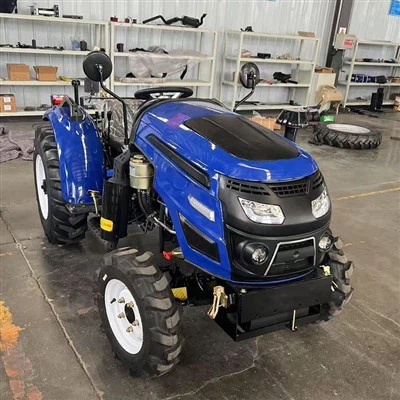
"In previous years, it took a week with my old tractor to plow 30 mu of land during the rush hour. This year, with the new tractor, I can finish the job in just three days, saving two barrels of fuel!" In a wheat field on the eastern Henan plain, farmer Wang Jianguo wiped the sweat from his forehead and gestured at the tractor on the ridge. During the critical autumn plowing season, a wave of tractors equipped with new technologies are proving effective in farmlands across the country. From intelligent operation to energy-saving design, from terrain adaptation to comfortable control, these upgrades have precisely addressed long-standing pain points faced by farmers, such as low efficiency, high costs, and fatigue, becoming a "new helper" for agricultural production.
Smart navigation overcomes manual dependency, allowing even novices to cultivate evenly spaced fields.
"In the past, plowing relied entirely on old experience, sowing seeds in narrow rows and wide rows. This not only reduced yields during the autumn harvest, but also caused the harvester to miss fields." Li Hongmei, a 20-year farmer, was once plagued by manual errors. Tractors equipped with intelligent navigation have solved this problem. Using a satellite positioning system, tractor operation errors can be controlled within 3 centimeters, enabling even young farmers to cultivate "standard" fields with evenly spaced rows.
These tractors are equipped with a multi-mode satellite receiver module that can simultaneously receive Beidou and GPS signals, maintaining stable positioning even in complex environments such as shaded areas and hilly terrain. Test data from the Agricultural Machinery Research Institute of Henan Agricultural University shows that using intelligent navigation tractors for sowing increases crop emergence rates by 8%, improves harvester efficiency by 15%, and reduces grain loss by an average of 20 kilograms per mu. Even more conveniently, some models support "offline operation." In remote farmlands without internet access, by downloading a pre-downloaded plot map, the tractors can autonomously complete the entire plowing, planting, and harrowing process, completely eliminating the traditional "dependence on the weather and the ground." Energy-saving power and cost reduction are "visible," saving "a cup of milk tea" on one acre of land.
"My old tractor consumed fuel like water. It burned 80 liters a day to plow 20 acres of land. This new tractor now uses only 65 liters for the same workload, saving me nearly 2,000 yuan per season!" Zhang Weiguo, a large grain grower in Liaocheng, Shandong, calculated the energy-saving performance of his tractors. The power systems of current mainstream tractors have been comprehensively upgraded. Through optimization technologies like high-pressure common rail and turbocharging, fuel efficiency has been significantly improved.
Comparative tests conducted by an agricultural machinery testing agency showed that a new 120-horsepower tractor consumes approximately 0.8 liters of fuel per acre, a 22% reduction compared to the old model from five years ago. In addition to traditional fuel-powered models, electric tractors are also beginning to gain popularity in greenhouse agriculture. In vegetable greenhouses in Wuxi, Jiangsu, electric tractors emit only 60 decibels, 25 decibels quieter than fuel-powered models. This minimizes pollination disturbances and reduces exhaust pollution. "A single charge costs 5 yuan, and I can plow 3 mu (approximately 1.5 acres) of land, which is only one-third the cost of fuel," said greenhouse grower Zhou Li. The low noise and low cost of electric tractors make them particularly suitable for the delicate operations within greenhouses.
Terrain adaptation breaks down "regional limitations," providing tailored solutions for both mountainous and paddy fields.
"Before, large tractors couldn't access my 5 mu (approximately 1.5 acres) of land on the mountain, so I had to dig by hand. Now, this 'small' tractor can even navigate the narrow ridges!" In the mountainous area of Xiangxi, Hunan, farmer Chen Yongming finally no longer has to worry about farming in the mountains. Tractor manufacturers have developed customized solutions for different terrains. Mountain models feature a shortened wheelbase design with a minimum turning radius of just 3.5 meters. Equipped with anti-skid tires, they can operate on slopes as steep as 15 degrees without slipping. Paddy field models are equipped with a sealed chassis and wide paddy field tires to prevent mud and water from seeping into the gearbox and reduce damage to the ridges.
On the black soil of the Sanjiang Plain in Northeast China, high-horsepower tractors can be paired with subsoil plows, achieving a 35-centimeter-deep tillage depth. This breaks down the "plow bottom layer" that has formed over time, allowing rainwater to penetrate more easily and increasing corn yields by 100 kilograms per mu. "Deep plowing used to require two tractors, but now it can be done with just one, and the depth can be precisely controlled, allowing the fertility of the black soil to be fully utilized," said Zhao Gang, a local agricultural machinery operator.
Comfortable design alleviates driver fatigue, eliminating back pain after long hours of work.
"I used to drive a tractor so hard that my hands and back ached, and I couldn't eat all day. Now the cockpit feels like a car, and I can drive for half a day without feeling tired." After experiencing the new tractor, Wu Tao, an agricultural machinery operator in Suzhou, Anhui, says he never wants to use his old machine again. Today's tractor cockpits have been upgraded from "a simple tin shed" to "a comfortable workspace." Seats feature lumbar support and shock absorption, filtering out 70% of vibrations. The cockpit is more airtight, significantly reducing dust and noise. The instrument panel uses an LCD display, clearly displaying data such as fuel consumption, speed, and working area. The control buttons are clustered near the steering wheel, making them easily accessible without bending over.
To meet the needs of nighttime operations, some models are equipped with LED panoramic lighting, offering a coverage range of up to 15 meters and three times brighter than traditional halogen lamps. "In the past, plowing the fields at night relied on a small headlight. Now, the view is as clear as during the day, allowing us to work four more hours during the busy farming season," said Wu Tao.
With the continuous advancement of tractor technology, more and more "new agricultural tools" are changing the face of agricultural production. From relying on experience to relying on intelligence, from high energy consumption to low energy consumption, from "makeshift" to "comfortable" use, every improvement in tractors is helping farmers solve practical problems and injecting tangible momentum into agricultural modernization. As Wang Jianguo said, A good machine not only produces more grain but also makes farming easier. Farmers can also catch up with the good times of technology!