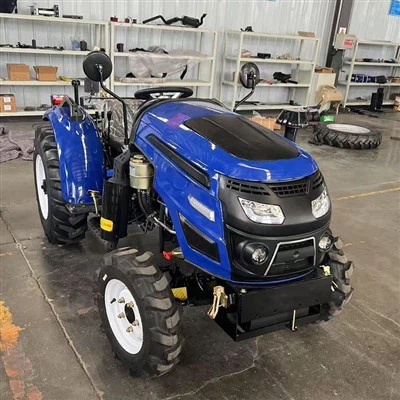
We are currently in the critical autumn sowing season in major wheat-producing regions like the Huanghuaihai region and the middle and lower reaches of the Yangtze River. Improving sowing quality and ensuring seedling emergence rates are key factors in determining next year's wheat yield. Modern tractors equipped with satellite positioning, intelligent sensing, and precision seeding devices are now demonstrating their prowess in wheat fields across the country. By precisely controlling sowing depth, row spacing, and seeding rate, they achieve "precision, standardization, and efficiency" in wheat sowing. This effectively addresses the challenges of uneven seeding depth and density associated with traditional sowing, laying a solid foundation for high and stable wheat yields next year.
Wheat sowing has strict requirements for seeding depth and density. Sowing too deep can result in seedling emergence difficulties, while sowing too shallow can lead to drought. Sowing too densely can easily lead to pests and diseases, while sowing too shallowly can waste land resources. Traditional manual sowing or simple machine sowing methods struggle to accurately control these parameters, resulting in seedling emergence rates often limited to around 80%. Precision seeding tractors equipped with the Beidou satellite positioning system achieve centimeter-level positioning accuracy, stably controlling seeding depth within an optimal range of 3-5 cm, with row spacing errors of no more than 2 cm, and increasing seeding uniformity to over 95%.
In the high-standard farmland of Hua County, Henan Province, agricultural machinery operator Master Li maneuvers his tractor at a steady pace, with the dashboard displaying real-time data such as seeding depth, row spacing, and speed. "In the past, sowing relied entirely on experience, with a maximum of 20 mu (approximately 16 acres) per day, requiring repeated checks and adjustments. Now, with this precision seeding tractor, we can sow 50 mu (approximately 16 acres) per day. After sowing, the system generates a sowing map, clearly showing how each field is progressing. The emergence rate is consistently above 90%.

To promote precision tillage techniques for autumn sowing, the agricultural and rural authorities have deployed over 5,000 technicians to the fields, providing on-site demonstrations of tractor precision seeding procedures and guiding farmers in adjusting sowing parameters based on soil moisture conditions and wheat varieties. Henan, Shandong, Hebei, and other provinces have also introduced "autumn sowing agricultural machinery subsidies," providing farmers with subsidies of 20-30 yuan per mu (approximately 16 acres) for using precision seeding tractors, with individual households receiving up to 10,000 yuan. To date, the adoption rate of precision seeding tractors in major wheat-producing areas across China has exceeded 75%, covering 120 million mu (approximately 16 acres) of sown area. This has significantly improved autumn sowing quality and laid a solid foundation for a bumper wheat harvest next year."