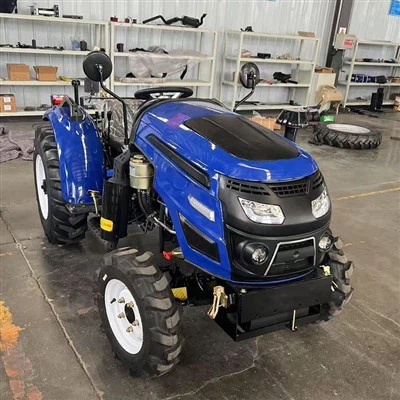
Recently, the tractor market has seen strong demand, with sales continuing to climb, creating both new opportunities and challenges for the tractor industry. With the country's vigorous promotion of agricultural modernization and the implementation of a new round of initiatives to increase grain production capacity by 100 billion jin, investment in agricultural machinery and equipment has continued to increase across the country. As core equipment for agricultural production, tractors have seen significant growth in market demand.
Sales data indicates that many tractor manufacturers have seen significant increases in orders. In the first half of this year, some companies saw sales increase by over 36% year-on-year, even experiencing supply shortages. In terms of product types, traditional high-horsepower tractors continue to enjoy high demand in major grain-producing areas. Their powerful power and efficient operation meet the needs of cultivating large tracts. Meanwhile, small tractors suitable for hilly and mountainous areas, as well as intelligent, environmentally friendly tractors, have seen particularly strong sales growth, becoming new market hotspots. With shifts in agricultural production methods and growing environmental awareness, these tractors with specialized features and advantages are increasingly favored by farmers and agricultural cooperatives.

To meet strong market demand, tractor manufacturers have increased their investment in R&D and production. On the one hand, companies are continuously increasing their R&D efforts, launching new product models, optimizing product performance, and improving product quality. By introducing advanced technologies and processes, they are enhancing tractors' intelligence, power performance, fuel economy, and operator comfort to meet the diverse needs of different users. For example, some companies are developing intelligent tractors that enable autonomous driving, precise operation, and remote monitoring, significantly improving agricultural production efficiency and management. On the other hand, companies are accelerating the construction of smart factories to improve production efficiency and shorten product delivery cycles. By introducing automated production equipment and information management systems, they are enabling intelligent and refined management of the production process, improving production efficiency, reducing production costs, and enhancing their market competitiveness.
Furthermore, companies are strengthening their collaboration with research institutes and universities to jointly promote technological innovation and promote the development of the tractor industry towards high-end, intelligent, and green development. Through industry-university-research collaboration, companies can fully leverage the talent and technical advantages of research institutes and universities to accelerate the development and application of new technologies and products, providing technical support for the sustainable development of the tractor industry.
Industry insiders analyze that with the continuous improvement of agricultural mechanization and the adjustment of the agricultural industrial structure, the tractor market will continue to maintain a positive development momentum in the future. At the same time, market competition will become increasingly fierce, and companies need to continuously enhance their core competitiveness to adapt to market changes and seize development opportunities. Driven by both policy support and market demand, the tractor industry is expected to usher in a new round of rapid development, providing a more solid equipment guarantee for my country's agricultural modernization.