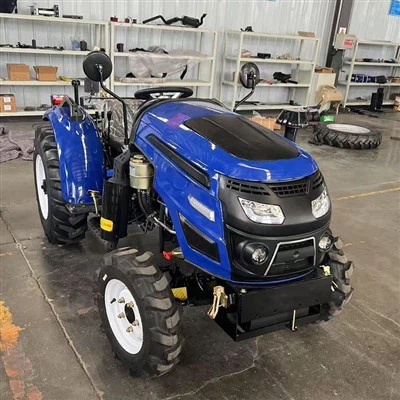
Recently, agricultural machinery exhibitions have been held across China. Tractors, a core exhibit, have become a focus for farmers thanks to the dual benefits of "policy subsidies and dealer discounts." At exhibitions in Urumqi, Xinjiang; Zhengzhou, Henan; and Harbin, Heilongjiang, the tractor exhibition areas were packed with visitors, with a constant stream of farmers seeking on-site consultations, testing machines, and signing contracts. Some popular models were even in short supply. During the exhibitions, over 3,000 tractor contracts were signed nationwide, with over 5,000 intention orders, injecting strong vitality into the agricultural machinery market.
Agricultural machinery exhibitions across the country, tailored to local agricultural production needs, showcased a full range of tractors, from small 20-horsepower models to large 120-horsepower models, covering diverse operating scenarios such as plains, mountainous areas, and paddy fields. To attract farmers to place orders, dealers launched "Exhibition Exclusive Discount Packages," offering far greater discounts than usual. First, they offered enhanced replacement subsidies. Farmers who traded in their old tractors for new ones received, in addition to national and local scrapping subsidies, an additional 2,000-5,000 yuan in dealer subsidies. Some brands even offered a "discount on old tractors + instant discount on new tractors" package, saving farmers up to 8,000 yuan. Second, they offered a wide range of practical gifts. Farmers who paid a deposit on-site received essential accessories like engine oil, filters, and agricultural tool sets. Those who paid in full received additional items like a car refrigerator and sun-protective clothing. Third, they offered flexible financial support. For farmers facing financial constraints, dealers partnered with banks to offer low-interest loans, with a down payment as low as 20% and repayments up to three years. In some areas, farmers also received government interest subsidies, effectively alleviating their financial pressures.

At the Urumqi Agricultural Machinery Exhibition, farmer Ma Jianjun spotted a 50-horsepower tractor. After trading in his old tractor and taking advantage of the exhibition's special offers, he was able to secure a 32,000 yuan discount on the usual price. He also received a year's supply of engine oil and a set of repair tools. He signed the purchase contract on the spot. "Normally, I'd have to wait half a month, but at the exhibition, I was promised three-day delivery, plus free on-site training. It was a fantastic deal."
To help farmers gain a firsthand understanding of tractor performance, the exhibition included a demonstration area simulating plowing, harrowing, and sowing. Technicians explained the key operating points and advantages of the equipment throughout the process. In the paddy field demonstration area at the exhibition in Zhengzhou, Henan, a tractor designed for rice paddies demonstrated its ability to avoid sinking, navigating mud up to 15 centimeters deep without slipping. This demonstration attracted a large number of onlookers from major rice-producing areas such as Xinyang and Nanyang. "Before, when buying a tractor, I could only listen to dealers' advice. Now, I can see the results with my own eyes, and I feel more confident." Xinyang farmer Li Juan, after a test drive, reached an agreement with the dealer on the spot, planning to purchase one for her 15 mu (approximately 15 mu) of rice paddies.
In addition to sales, the exhibition also provided a technical consultation area where agricultural machinery experts answered farmers' questions on tractor operation, maintenance, and troubleshooting, helping them choose the model that best suits their needs. The Harbin exhibition in Heilongjiang also held a "Tractor Operation Skills Training," inviting experienced agricultural machinery operators to teach on-site operating techniques, attracting over 200 farmers. The exhibition organizers stated that agricultural machinery exhibitions are not only platforms for connecting supply and demand, but also vehicles for technology promotion and service delivery. They will continue to increase the frequency of exhibitions in the future, allowing more farmers to learn about the latest agricultural machinery products and preferential policies without leaving the province, thereby promoting further advancements in agricultural mechanization.