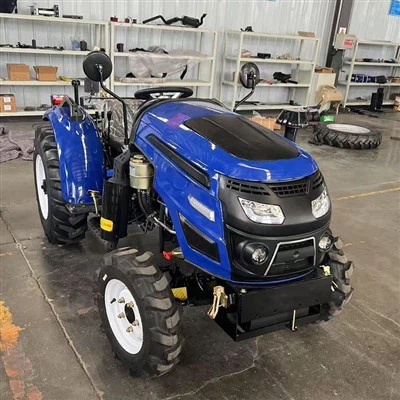
Tractors can be categorized in several ways, primarily based on their configuration, primary use, and functionality. Here are the common types:
1. By Configuration
Wheeled Tractors
Description: The most common type, using rubber tires. They typically have two driving wheels (rear) and two steering wheels (front), but four-wheel-drive models are also widespread.
Advantages: High travel speed, good maneuverability, high transport efficiency, suitable for a wide range of field operations and road transport.
Applications: Plowing, seeding, cultivation, hauling.
Crawler Tractors (or Track Tractors)
Description: Use continuous tracks instead of wheels.
Advantages: Low ground pressure, excellent traction and grip, superior performance in wet, soft, or muddy conditions.
Disadvantages: Slower travel speed, not ideal for long-distance road transport, can damage paved surfaces.
Applications: Heavy-duty plowing, wet land operation, sloping land, construction projects.
By Purpose
Agricultural Tractors
Utility Tractors: The most common agricultural tractor, equipped with a three-point hitch and PTO, capable of operating a wide variety of implements for all-around farming tasks.
Row-Crop Tractors: Feature high ground clearance and adjustable wheel treads to easily navigate between rows of tall crops (like corn, cotton) for cultivation, spraying, and fertilizing.
Orchard Tractors: Compact in size with low-profile cabins (or no cabin) and smooth, rounded bodywork to prevent damage to fruit trees and their branches.
Industrial Tractors
Description: Often referred to as "traction engines" or "loaders," they are usually equipped with hydraulic transmissions and a robust front-end loader.
Applications: Construction sites, logistics yards, ports for earthmoving, material handling, and bulldozing.
Garden Tractors (or Lawn Tractors)
Description: Small tractors designed primarily for maintaining lawns, gardens, and smallholdings.
Applications: Mowing lawns, landscaping, light hauling.
By Power Output (Horsepower - HP)
Compact Tractors (Typically under 50 HP)
Mid-Range Tractors (Typically between 50 to 100 HP)
High-Horsepower Tractors (Typically between 100 to 200 HP)
Ultra-High-Horsepower Tractors (Typically above 200 HP)