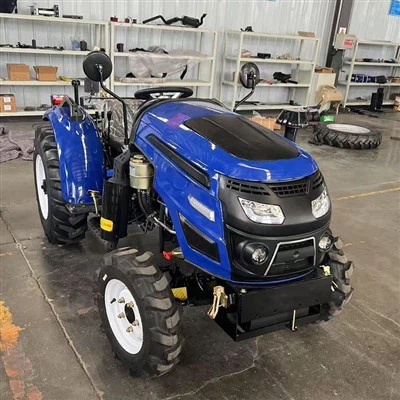
What is a Disc Plough?
A disc plough is an agricultural machine that uses one or more sets of concave discs as working components to turn and loosen soil. Compared to traditional mouldboard ploughs, the disc plough employs a rotating cutting and soil-turning action, making it particularly suitable for challenging conditions such as straw-return fields, hard soils, weedy fields, and orchard cultivation. It is an essential tool in modern high-efficiency agriculture and conservation tillage systems.
Core Advantages and Working Principles of Disc Ploughs
Key Technical Features:
Rotating Soil-Cutting Design: Discs cut into the soil through rolling motion, reducing resistance and energy consumption.
Strong Passage Capability: Effectively cuts through straw, roots, and weeds, minimizing blockages.
Wide Soil Adaptability: Efficiently operates in everything from light sandy soils to heavy clay soils.
Stable and Controllable Tillage Depth: A weighting and angle adjustment system ensures uniform tillage depth.
How to Choose the Right Disc Plough?
Five-Step Selection Method:
Match Tractor Power: Approximately 40–50 horsepower of traction is required per meter of working width.
Analyze Soil Type: Choose larger-diameter discs for heavy clay soils.
Consider Crop Residue: Opt for wide-spacing designs in areas with high straw volumes.
Evaluate Operational Scale: Hydraulic folding models are recommended for areas exceeding 500 mu (approximately 33 hectares).
Confirm Terrain Characteristics: Choose models with leveling adjustment functions for sloped land operations.
Economic Benefit Analysis:
Increased Operational Efficiency: 30–50% faster working speed compared to traditional ploughs.
Fuel Savings: 15–25% reduction in fuel consumption per unit area.
Comprehensive Cost: The investment payback period is typically 1–2 growing seasons.
Guidelines for Proper Use and Maintenance of Disc Ploughs
Daily Operational Tips:
Adjust Before Operation: Modify disc inclination based on soil moisture.
Speed Control: Optimal working speed is 5–8 km/h.
Depth Management: Gradually increase tillage depth to avoid sudden overload.
Frequently Asked Questions (FAQ)
Q: Is a disc plough suitable for paddy field operations?
A: Yes, it is particularly recommended for rice straw return operations, as it effectively cuts and buries straw. However, specialized models with mud scrapers are advised.
Q: How is uniform tillage depth ensured with a disc plough?
A: Through the integrated adjustment of the three-point hitch system, depth-limiting wheels, and a weighting system, our products are equipped with an intelligent tillage depth control system, ensuring depth errors of less than ±1.5 cm.
Q: What advantages do disc ploughs have compared to rotary tillers?
A: Disc ploughs achieve deeper tillage, provide better subsoil loosening, and do not disrupt soil structure, making them more aligned with conservation tillage principles.
Why Choose Hanhong International Disc Ploughs?
Each product undergoes a 50-hour durability test before leaving the factory.
Globally unified standards, compliant with CE and other international certifications.
Global Service Network:
Multilingual technical support and remote diagnostics.
Professional operational training videos and manuals.
Customer Success Story:
"Since purchasing the Hanhong HD-280 disc plough in 2022, our 4,000-mu cornfield has seen a 40% increase in tillage efficiency, a 22% reduction in fuel costs, and significant improvement in straw return effectiveness."
- John Miller, Farmer, Alberta, Canada
Get Your Customized Solution Now
Contact us for:
Free soil adaptability analysis
Personalized configuration plans
Real-time online demonstrations
Detailed economic benefit calculations
Hanhong International is committed to providing efficient, reliable, and intelligent agricultural machinery solutions for global agriculture. Our disc ploughs have served 23 countries and regions worldwide, with a cumulative operational area exceeding 20 million mu.